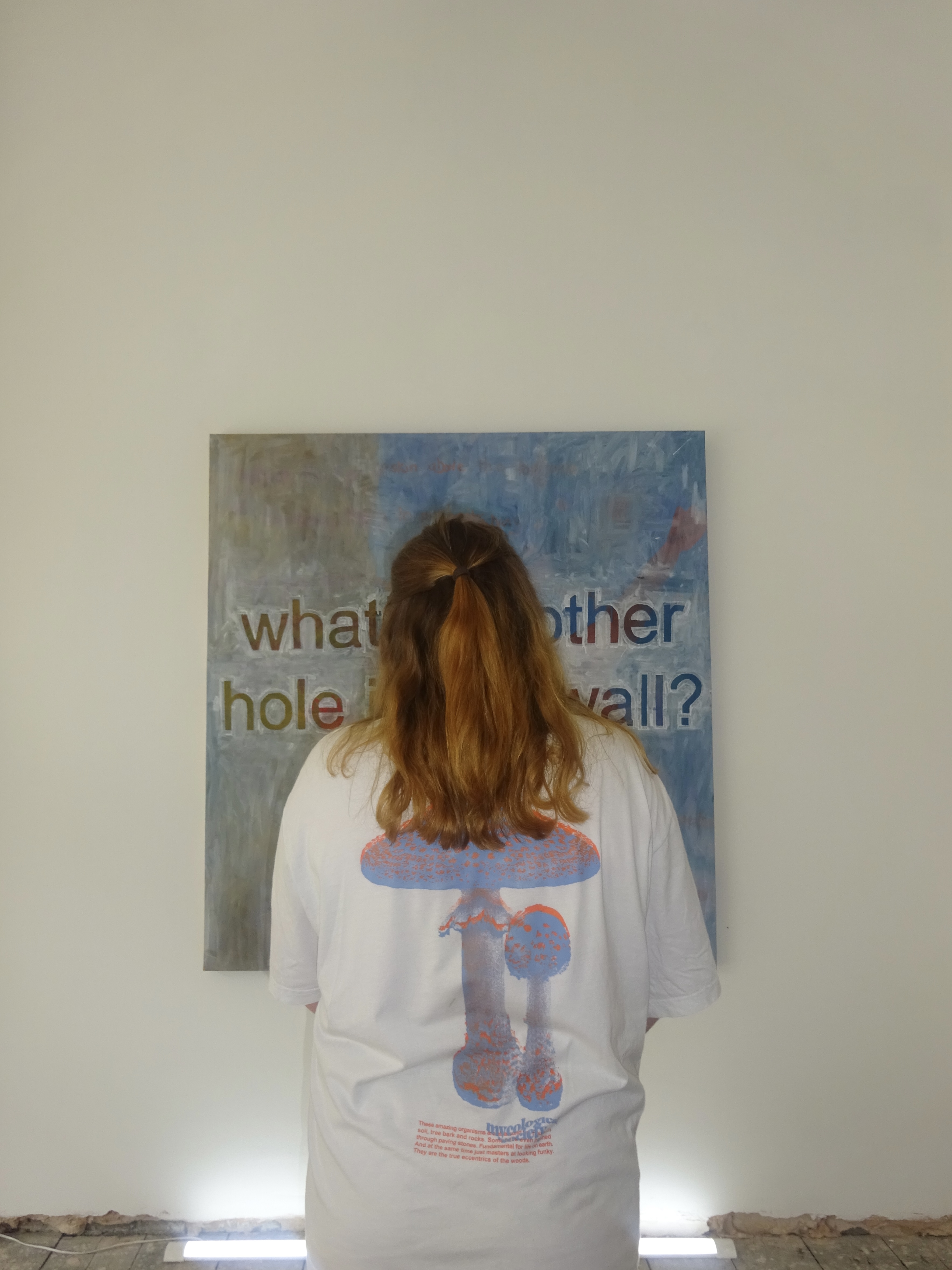
The Bomb Factory Art Foundation was kind to me, blowing cool, conditioned air on a day when perspiration could no longer bothers you. Because what’s the point? Being annoyed by it only makes it worse, and not being bothered has the same effect. So, The Bomb Factory Art Foundation was kind to me. I had already looked around and stumbled upon a piece called “What’s Another Hole in the Wall?” I didn’t initially ask what it was supposed to mean. I figured it was probably something you had to arrive at on your own. However, after a moment, I was approached by the artist, who goes by Maisie Ridpath. She didn’t know it yet, but I had some questions brewing for her.
To Start With…
We began, of course, with introductions and a bit of background—because that’s what needs to happen before you get into the nitty-gritty.
Ridpath: I’m currently studying Fine Art at Central Saint Martins. I’m in between my second and final year because I’ve been doing a year of internships.
Really valuable. I’ve had some great opportunities and met a lot of interesting people. It’s helped me understand the art world more deeply and how many people are navigating it with similar uncertainties.
With this, I had to promptly ask her about the piece that I saw. I blame my impulsiveness, as this was not the order of questions I had prepared. But I let it flow regardless.
Ridpath: That’s a great one to talk about. I like to start by saying I don’t believe my paintings need a direct explanation. I’m more interested in ambiguity leaving space for people to project their meaning. It’s like with graffiti: you walk past it, read something, and it lingers in your mind, even if you don’t know why.

Hearing Ridpath say this, I gauged that her work was more about emotional resonance than a clear, point-blank interpretation.
Ridpath: Exactly. Sometimes you don’t have to “get it” logically it can just sit with you emotionally. I love it when people ask themselves, Why did that stick with me?
That ambiguity is intentional. That piece came from thinking about capitalism, social structures, and how many rules we just accept. I was reading about Trump not as a politician but as a businessman how he built a golf course in Scotland and displaced people to do it. There’s a book called Burn Before Reading that documents it. It really made me think about cultural erasure.
The Midpoint…
We conversed a little more about the intensity of the piece and how the title ‘What’s another hole in the wall’ ties into these themes.
Ridpath: “Hole in the wall” has different meanings. In the US, it’s a term for a small restaurant; in the UK, it refers to an ATM. I love that duality; it plays into the idea that, depending on your context, your interpretation changes. It also reflects how culture can be casually dismissed, like “oh well, just another one lost.”
This had never come to mind when I first saw the artwork, and when Ridpath mentioned it, I realised something. I had always assumed it was just the restaurant’s meaning. Not knowing the UK meaning, I felt flushed with embarrassment. However, the size of the piece is something you cannot ignore. This also ties in with its intensity. It somehow feels invasive and demands you find your own meaning, which I very much appreciate. So, I of course asked Ridpath if the canvas size factors into her work. And whether she thinks about it during the creative process.
Ridpath: I do, but it’s often limited by space. I’ve been working from my bedroom this year, so large-scale work has been difficult. But I love working big, especially in galleries where I can be bold and even a bit vulgar. I respond to space when I exhibited in someone’s house, I made something small and intimate. It’s always changing.
With the talk of ratio within her canvases, I thought of which was her favourite piece. And if it was different from the one with which we started.
Ridpath: ‘Sanguine’. It’s based on the word sanguine, which has two meanings: a deep blood-red colour and an overly optimistic attitude, even in the face of disaster. It’s about toxic positivity like being in a car crash and saying, “Everything’s fine!” The contrast of those two definitions felt really powerful to me.

The font stood out when I was looking at ‘Sanguine’ and noticed that each of Ridpath’s works had distinct fonts. Why was this? Was it significant? The questions were scattered.
Ridpath: I’m obsessed with fonts. I found the typeface and then cut out a stencil by hand. I used a pouring medium for the background and lacquer to give it that glossy finish. Every painting is an experiment for me I’m constantly trying new methods.
I love books and text how a sentence can wreck you. I wanted to give written words weight, texture, and a presence you can’t ignore. It’s a bit like saying, “You have to sit with this.”
Going back to the point that Ridpath’s previous work had themes of capitalism, I wanted to know if any other work shared this. With my luck, there was, and it was called ‘All Talk and No Trousers’.

Ridpath: This piece came from reading Mark Fisher’s Capitalist Realism. He compares capitalism to a call centre you get passed around endlessly but never reach a conclusion. There’s no “centre,” just constant redirection. I pictured it as an optical illusion those loops that never close. It’s also about social dynamics: toxic friendships, popularity contests cycles that exhaust you with no real payoff.
It’s about that moment of clarity when you realise you’re stuck in motion, with no real destination.
The Wind-Down…
Our conversation was coming to an end, but I still felt there was more to discuss. However, I needed to know what her plans were for the near or distant future. Since she was going back to CSM in September, was there anything she would take away from this year out?
Ridpath: This year gave me space to experiment with humour in my work. I’ve always wanted to make politically sharp, funny pieces, but it’s hard to explain humour in art school. It’s like explaining a joke; it ruins it. I’ve finally started to find a way to blend accessibility, wit, and politics, especially through graffiti-inspired aesthetics.
I could cut and slice up the ending of our conversation, but I thought that would be cruel. So I’m choosing not to and letting the dialogue speak for itself:
Me: And you’ll have a studio space again?
Ridpath: Yes! I cannot wait. My room is basically a hazardous materials zone fabric everywhere, pins on the floor, and fumes in the air. I’m so ready for a space that doesn’t double as my bedroom.
Me: I feel that. The cost of art school is wild, too.
Ridpath: It’s brutal. Materials, framing, travel it adds up. Sometimes tutors suggest things that are just not affordable. I’ve had to repurpose materials, scavenge, even steal things (ethically, of course!). It’s frustrating when people don’t acknowledge how much access and privilege shape what you can create.
Me: Especially when internships are unpaid.
Ridpath: Exactly. I actually wrote my end-of-year report outlining basic rules for internships. Like, if you can’t meet these criteria, you shouldn’t have interns. If I’m working for free, there should at least be travel expenses covered and basic respect. 100%. People forget how much we’re expected to give time, labour, even our own money.
Right? It’s not just our time; it’s a real financial strain. I’ve been in meetings where people casually throw around big budgets, and I’m sitting there thinking, Can someone just cover my lunch? A little gesture would go a long way.
I urge you to take a look at Maise Ridpath’s work. And if I don’t sound stern enough, let me be clear: go look at it immediately. I hope you heard my foot stomp with a crescendo as I bellowed those words
Find a sentence that can wreck you, words that have weight. Make them have texture and hold this presence that you cannot ignore.
Thank You, Masie Ridpath. I look forward to your next project.
Related Articles

Leave a Reply